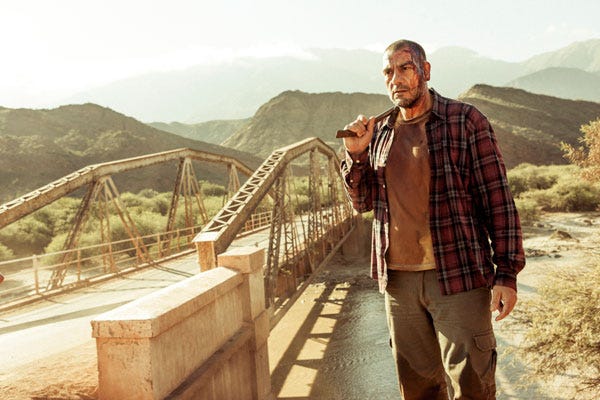
Road to Hell
The third short film from Wild Tales (Damián Szifron, 2014)

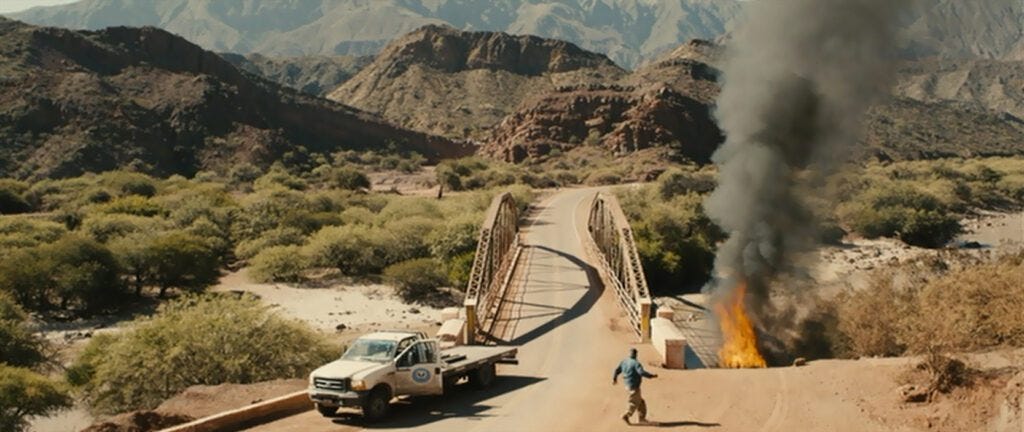
Road to Hell, the third of six short films, depicts the story of a man driving a sports car along beautiful scenery, until his journey is disturbed by a man driving an old pick-up truck who is hogging the road. When the sports car eventually passes him, the driver flashes the middle finger. Later, his sports car has to stop by a bridge due to a flat tire, but the pick-up truck finds him and wants to get his revenge, which soon turns into the worst road rage ever! It evolves into a battle of insults and damage to each others’ vehicles, and even turns into car crashes and attempts to murder each other! This extreme violence leads to both men being killed in an explosion and both losing the fight.
The Narrative:
The film begins with a beautiful shot of a man driving a sports car along an empty road surrounded by mountains on a gorgeous day, accompanied by upbeat music to reflect the man’s positive mood. This is soon interrupted by a man in an old truck who is intentionally taking up the road, which pauses the music but continues after they finally pass each other. At first, we are under the impression that the rich man is the protagonist and will be the “good guy,” and the man in the truck is the antagonist, however we soon learn that they are both as evil as each other due to their constant conflict throughout the film. I really like how, until the end, these two are the only characters because it shows how isolated they are and that they are only focused on the other person. Road to Hell is told in a linear, three act structure to make it easy to follow, as the director’s intention was just for audiences to focus on the action. I would say that there is an arc within the characters, as they get increasingly violent throughout the film, and I believe that these two men are the epitome of the effects of testosterone, as they just constantly try to one-up each other without thinking of the consequences, and is at times almost humorous how far they are willing to take it.
Cinematic Influences:
Due to Argentina having a corrupt social system during the time of the film’s invention, the director wanted to take a stand against social constructs, which he did in Road to Hell through showing people that released their primal instincts in extreme acts of violence to portray the universal appeal of “we can all lose control,” which is very obvious within this film. I also think that this film reflects the historical context of Argentina too, as it shows a class divide between the man with the old, dirty pick-up truck and the wealthy man with the clean, expensive car, but proves that all humans are the same despite their income, as 2014 was a time of economic uncertainty. I think that the genre of Road to Hell is clearly an action from start to finish, as they violence is never-ending, however it also has elements of a comedy because it was funny to watch these two men battle each other in front of such beautifully, peaceful scenery, so this dramatic irony made the film quite comedic, as well as the entertainment of seeing how far these characters will go to get revenge. The film’s mise-en-scène is memorable because of the contrast between the beautiful location and the action and violence between the two main characters. Also, fog and dust are used to signal the arrival of the truck when the man is changing his tyre to create a dramatic effect and foreshadow that something bad is about to happen, which was a small aspect that I really liked. Sound is used effectively because music is used at the start to create a positive atmosphere, however the music is not heard again after the man’s tyre becomes flat. This is intentional because it allows for audiences to focus on the action and make it seem more realistic and painful because you can hear every small movement. There is a sequence when the two characters are fighting in the car and the radio is playing, which provides comic relief because it is ironic how there is joyful music playing in the background of their extreme violence. The film is edited quite simply, with quicker jump shots during action and fight sequences to make the pace feel more rushed and dramatic. I enjoyed the performances because there was hardly any dialogue and instead, the actions described what was happening, which was unusual because most stories in Wild Tales are told more through dialogue than action. The combat scenes were very realistic, which was achieved through lots of training for the actors and well-timed match-on-action editing. The actors told their characters’ emotions through their facial features, for example, you could tell that they were angry because they bared their teeth and lowered their eyebrows as they looked up in frustration at the other person. Finally, I was really inspired by the film’s cinematography because it was filmed at low angles that were very close to the action. It changed constantly and these uncomfortable angles made viewers feel like they were part of the fight. There was a moment at the beginning as the man is driving, where the camera is inside the car and is at eye-level to the actor, so it’s like a first-person position and feels as though we are in his shoes, which creates a bond with the first character that we meet.
Creating Meaning and Effect:
Road to Hell represents men from different classes, and reinforces each stereotype - that the man in the dirty truck is disgusting and violent, and the wealthy man in the expensive car is arrogant and cruel, which we definitely see in this film. It also reinforces the stereotype that men are violent and will not stop trying to one-up the other, even if that behaviour is immature or dangerous. The dominant message of the film is to be careful when letting your animalistic side out (especially with men) because it can lead to consequences that you weren’t prepared for and that you will regret, and to know when to stop and just do the mature thing instead of acting like animals. Both characters think that the other person is the problem, but they both are and just won’t realise it because they’ve gone too far into the fight, which is a key message within this film. I like the aesthetic of this film because the setting is warm due to the harmonious colour tones from the orange mountains, yellow sand and bright sun. This creates a peaceful mood, which contrasts the action between the characters. In addition, this warm colour palette could be used to represent the anger that the characters feel. The pace is slow at first to establish a calm atmosphere, however the pace quickens as the film progresses to show how the characters’ violence increases. This aesthetic is typical for this director because we see this contrast between the beautiful setting and terrifying action in every short film in Wild Tales.
Overall, I really enjoyed Road to Hell, and it is my favourite of all six short films because the constant action and conflict keeps you focused and aware all the time, therefore did not bore me at all. My favourite moment from the film is when the rich man is being strangled by a seatbelt and the other man is trying to set the car on fire, as the tension is unbearable because you don’t know if they will survive. I love how just as you think it couldn’t get worse, they continue to fight and take it to the next level by attempting to kill each other!
⭐️⭐️⭐️⭐️